Prefabrication in Construction: Types, Costs, and Real World Examples
In construction, more people are turning to the design-build approach and Prefabrication. It’s faster, saves money, and brings some creative solutions to the table. Thus, when compared to conventional construction, this approach is significantly ahead.
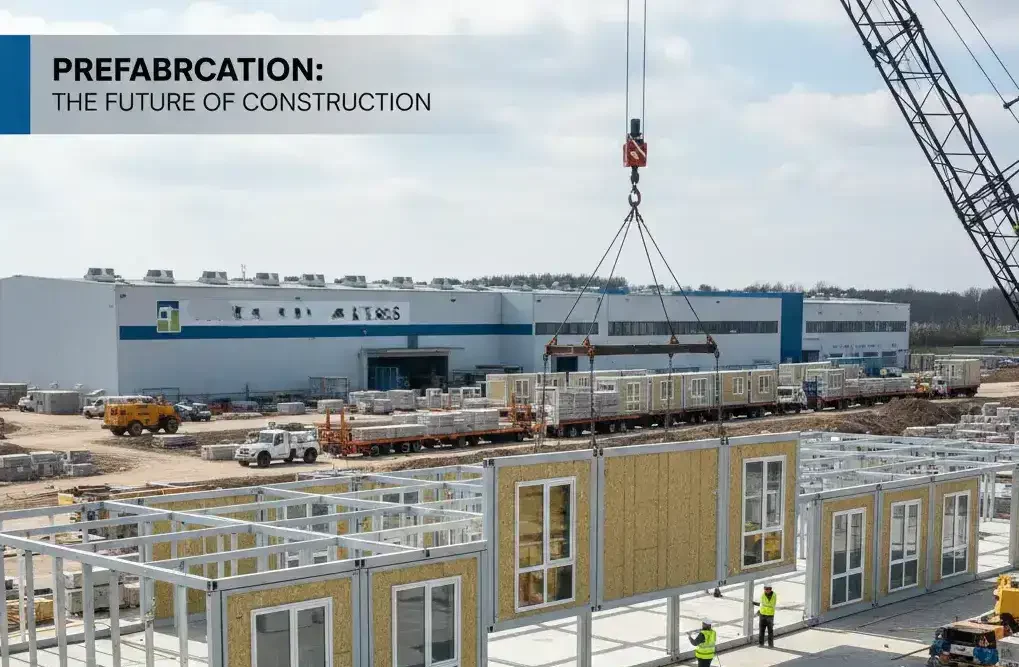
With this construction approach, instead of building the frame on-site, it would be constructed off-site in a factory that has a controlled environment. After the components of the frame are constructed, they are checked, then sent to the construction site. This method is famous for its quick delivery with less wastage and improved quality.
UNCOVER WITH US ALL THE ASPECTS OF PREFABRICATION AND FIND OUT HOW IT YIELDS BETTER OUTCOMES!
Prefabrication – An Improved Construction Method
Also referred to as Prefab, it is a construction method in which components of a building are constructed in an off-site facility and then transported and assembled on the construction site. This construction technique leverages precise manufacturing in controlled conditions that results in efficient construction.
Why Does it Surpass Traditional Construction?
You may now know that this construction takes place in a controlled factory setting. This means that, unlike traditional construction, which is subject to various uncontrollable factors, this construction method is free from them entirely.
Traditional on-site construction is prone to unexpected weather conditions, a shortage of labour, workplace incidents, and more. Whereas Prefabrication in Construction is done in a monitored environment that greatly reduces these potential risks.
Going ahead, we will discuss the types in which this construction method is carried out.
Prefabricated Construction Types
1) Modular Construction
This method is also known as volumetric construction. These three-dimensional units, or modules, are manufactured. These modules are almost 85% completed before transporting them to the construction site.
Note that each of these modules, depending on the demand, can be a whole room or a segment of the building. Also, these modules come with interior finishing as well as MEP systems installed.
2) Panelized Construction
In this prefabricated construction, walls, floors, and roofs in the form of panels are manufactured. Also, along with these panels, the framing skeleton and sheathing are involved. On the other hand, it can also encompass already installed windows and doors.
Note that these panels are 2D components that require on-site assembly. These can be in the form of open and closed panels. Open panels include only framing, while closed panels come with insulation and exterior finishing.
3) Hybrid Construction
This approach is the combination of on-site construction techniques in which building components are prefabricated. This means that it provides adaptability along with prefab features.
Note that this technique is usually optimal for complex architectural designs.
4) Segmental Construction
This construction includes pre-fabricating specific segments of a building. It can be a roof, bathroom, stairs, or racks for MEP systems.
Cost Inferences of Prefabricated
To determine the costs, first, you need to understand the contributory factors that can cause cost variations. The most well-known factors that cause the cost to vary are the type of magnitude of a project. Also, the level of complexity and location can increase the costs as well.
WHAT YOU NEED ARE THE PROFESSIONAL ESTIMATING SERVICES FOR YOUR FINANCIAL GUIDANCE, SO HIRE US TODAY TO GET THE BEST WITHIN YOUR BUDGET!
The following are the major cost implications that must be looked out for:
Initial Investment
This method is highly precise, and that is because of the efficient design and engineering professionals. Also, another major expense that is a must in this method is the transportation cost.
Material
Because material is purchased in bulk, this leads to lower material costs. On the other hand, it also reduces construction waste up to 55%.
In some prefabricated methods, such as Modular, in which entire rooms are built off-site with installed MEP systems, expert HVAC Estimating Services for Prefabricated Systems become essential. This is because they will plan for the materials costs for pre-assembled HVAC units, ductwork, and piping systems.
Labour
Where in traditional construction, labour takes up the major portion of the budget, this method is the complete opposite. Not only will the controlled environment labour be more efficient, but your on-site labour requirements will be reduced up to 45%. In addition to that, weather and time-related issues would not be a problem as well.
Comparative Cost Analysis
- Modular method, on a per square foot basis, can go up to $385 when compared to traditional construction. But the overall cost of the project becomes lower because of the time saved
- Panelized construction is around 15% more expensive than traditional construction. But that increase is offset due highly reduced labour force and time.
Possible Limitations of Prefabrication
Restricted design flexibility
Most of these offer limited design options. This includes Modular and panelized construction methods. In these methods, the architecture is pre-designed with no room for customisation. Especially modular because it comes with completed rooms with MEP systems already installed. Thus, for this method, professional Mechanical Cost Estimating for Prefabricated Systems is necessary. This is because they will analyse the modular design and ensure that the right HVAC system is chosen that fits the prefabricated design parameters.
Logistics complications
Transportation of such massive structures can be quite tricky, particularly in urban areas. Thus, a carefully assessed route transportation plan is devised to find out the best possible route.
Real World Examples of Prefabricated Buildings
1) B2 Tower in Brooklyn, NewYork
This building stands 32 stories tall and serves as a residential apartment complex. The team finished the project with 930 prefabricated modules built off-site.
2) CitizenM Hotels
This hotel has chosen prefabricated construction methods for its buildings in North America. Most of their hotel rooms were transported on-site as a complete module with all finishes and fixtures.
3) Modular Classrooms Buildings
Numerous schools in California have employed modular classroom buildings.
Ending Remarks
Building design and construction have been completely transformed by prefabrication. Because of this, traditional construction has been rendered entirely obsolete, and building design and construction are turning a larger profit. Also, this method is promoting a greener future, which was not possible with traditional construction. On the other hand, there are still some challenges to tackle with this construction. To fully grasp what this method entails, read this article to know the types, cost implications, along successful real-world examples.